Technical Spotlight - Audi Revolut F1 Team
Audi R26 – A Concept Morphing into Itself
Debut philosophy – A conservative but expandable base:
Audi’s debuting R26 was never meant to wear the 2026 regulations’ most daring look. It is purposefully a modular starting point, leaving wiggle room in many areas for aerodynamic and package upgrades as the season progresses.
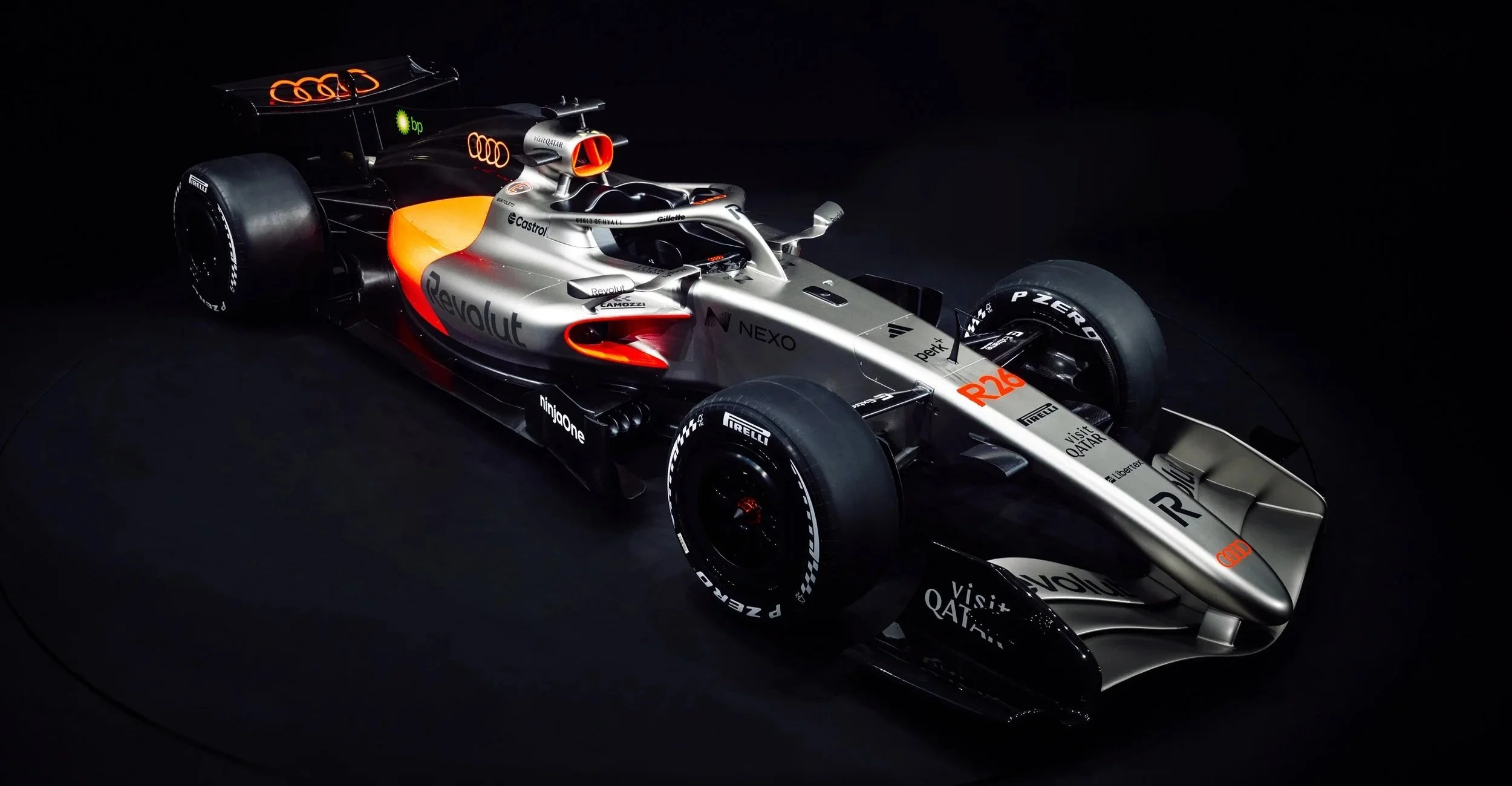
R26 Launch in Berlin
Most Crucial Attributes Shown at the Berlin Unveiling
A fairly “honest” body. There were no extreme undercuts or daring top-surface elements. The team’s approach was clean with conventional sidepod and engine‑cover solutions. Cooling inlets sized cautiously rather than optimistically. Audi clearly wanted to keep a high margin for heat rejection of the PU and MGU-K before learning what the power unit really needs. Suspension and platform choices that prioritised predictable kinematics and straightforward setup changes over exotic geometries, telling of a team aiming to minimise the base platform’s arising issues.
In other words, the launch-spec R26 looked like a “Phase 0” car. Its robust structure, standard aero package, and a philosophy that will improve along with data correlation, allowing for more aggressive chassis setups, rather than aiming to be a force of nature from day one.
Barcelona Shakedown – The Concept’s First Reality Check
How the evolved team looked on track
Barcelona altogether exposed the first iterations’ subtleties and restrictions. The aerodynamic platform seemed very stable right from the get-go, allowing the different aero specifications to be experimented with, but didn’t generate extraordinary downforce or drag efficiency, as I’ve described earlier, it was designed not to bring any major surprises. The cooling and PU integration were clearly still in the learning phase, as the team suffered several disruptions during their runplans, leading to the troublesome first few days on track.
The shakedown-spec R26 was really just a car that allowed the team to experience and learn from early limitations, and to give a more encouraging incentive to improve before the soon-approaching test in Bahrain.
Signs from Barcelona that Convinced Audi to Change
The shakedown’s most important learning outcome was problem-solving. Audi confirmed that the basic architecture (PU layout, cooling circuits, chassis stiffness, floor concept) did not contain any fatal design flaws, though software, thermal management, energy usage, and active aero element coordination required more fine-tuning.
Barcelona taught Audi to tighten the package, in all areas where big margins were kept, such as chassis and cooling. The first shakedown was also an incentive to speed up aerodynamic development, so the platform may get closer to leading aero trends with stronger undercuts to move airflow away from the front wheel wake, and direct it along the floor edge to feed the rear diffuser.
Bahrain Test 1 & 2 – The Sidepod Pivot
Audi surprised everyone with their new and radical sidepod concept, revealed during the second week of testing. I may be naïve, but I instantly got taken back to Bahrain testing in 2022, where it was Mercedes who unveiled their remarkably radical new aero philosophy, the renowned “zero-pod” design. Of course, in hindsight, we know it was remarkable mainly for its looks, not necessarily for its performance. To me, the design also resembles the intakes of the remarkable Concorde, humanity's first and only supersonic passenger plane, making it even cooler.
Audi’s version also morphed from a wide horizontal sidepod inlet into a vertical, much narrower inlet design, but the sidepods are definitely still present. The new sidepods and chassis clearly pivoted from “safe and modular” to a concept-led and aggressively sculpted philosophy.
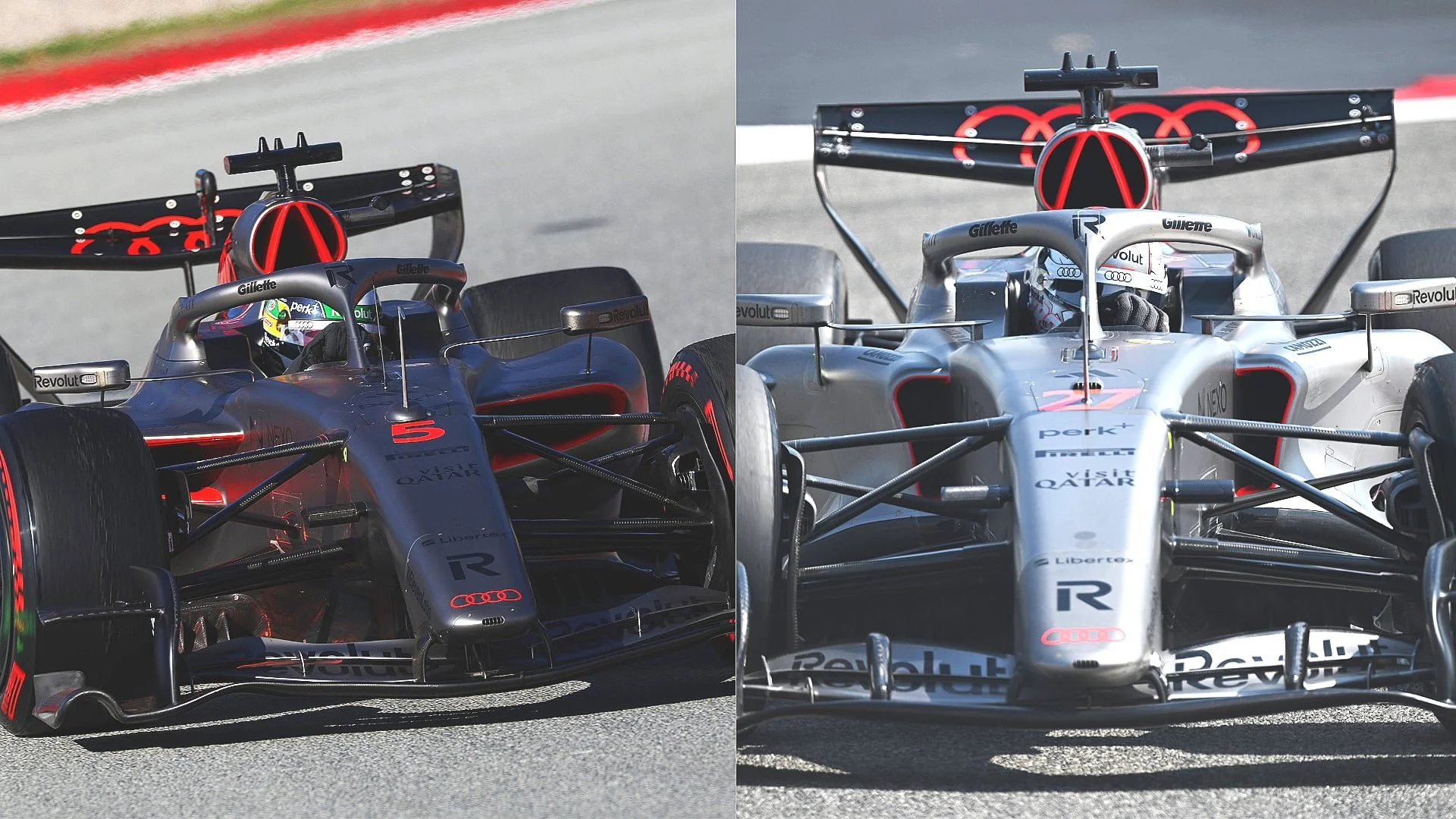
A side-by-side view of the R26’s sidepod changes
On the left is the launch and shakedown spec, on the right the version which hit the track on the first day of Sakhir testing.
Most Notable Changes
1. Inlet and undercut
The new package alters the flow‑control logic of the car. The sidepod inlets shrink and move towards a tighter, sleeker undercut profile. The undercut volume under the inlet is increased, opening a deeper channel for airflow to be guided along the flank of the chassis and towards the floor edge and diffuser. In essence, Audi went a similar direction to the big guns in the field, such as Ferrari and Mercedes, and is betting on floor-driven performance. So the new sidepods are responsible for feeding high-energy airflow under and around the car.
2. Downwash and waterslides
The upper surfaces of the sidepod develop more pronounced “waterslides” – sculpted ramps that send air downwards and rearwards towards the beam wing and active rear wing. Wake travelling from the front wheels and the suspension is redirected by these new surfaces, before it hits the rear of the car. This is particularly important in 2026 because active aero means the rear wing and beam wing are working in very different states across a lap. Audi’s new shapes appear aimed at giving the rear end a reliable intake of attached, well-aligned flow in both high‑downforce and low‑drag modes.
3. Engine cover and cooling exits
The engine cover tightens around the PU, and the hot air exits become more specific in size and placement. This reduces blockage ahead of the rear wing and beam wing and cleans up the overall wake structure at the back of the car.
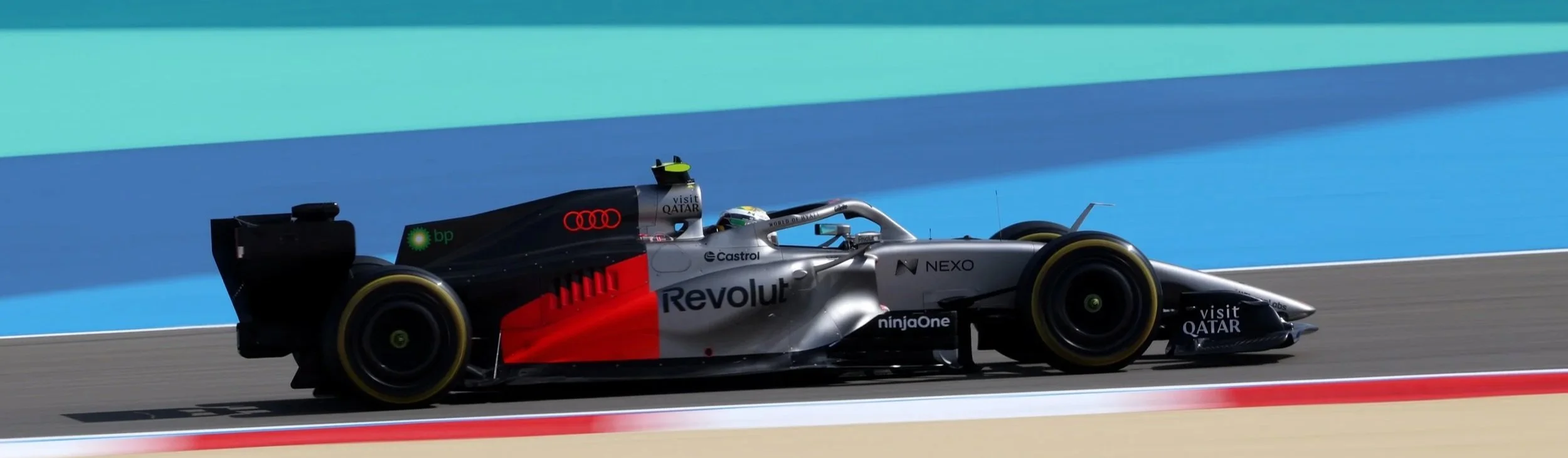
How the new sidepods change car behaviour
Hypothetically, Audi’s new philosophy puts the R26 in a place where the platform’s sensitivity increases, yaw movements improve, and the drag/downforce trade-off gets sharper. But what does this mean?
As the floor is increasingly fed, ride-height adjustments and mechanical platform stability become even more critical. During the second test, Audi experimented with different variations. The improvements in yaw movement allow for more stability in corners, keeping the car level and preventing it from leaning as much. This leads to greater downforce generation in medium to high-speed bends, while providing a stable feel for the drivers and more confidence when having to corner under braking, achieving enhanced energy recuperation. Lastly, the more tightly packed philosophy should, in essence, reduce overall drag, but it is most beneficial if other components of the car can benefit from this reduction and cleaner airflow, without experiencing separation with unwanted vortices.
As far as driver feedback goes, which is not at all to be overlooked when developing a brand new car, Hülkenberg described the Bahrain upgrade package as a significant step forward compared to the launch-spec, highlighting a major improvement in high-speed sections.
Audi’s improvement from the conservative, debut version to the much-improved and aggressive Bahrain test 1 package reveals how the handling of the R26 is proving progressively more comfortable for the team, and now acts as a closely integrated system.
Improved running
The completed kilometres drastically improved: 354 laps and 1916 km in Test 1, and 357 laps and 1932 km in Test 2, compared to the 240 laps in Barcelona. This enduring performance placed Audi in the midfield mileage-wise.
Long runs, aerodynamic changes, and robust PU mapping replaced the troublesome nature and issues of the shakedown. At this stage, the philosophy had to prove its architectural performance and provide the drivers a setup window stable enough to encourage aggressive driving rather than disapprove of it.
Biofuel and PU Strategy – Playing the Long Game
Early homologational advantage
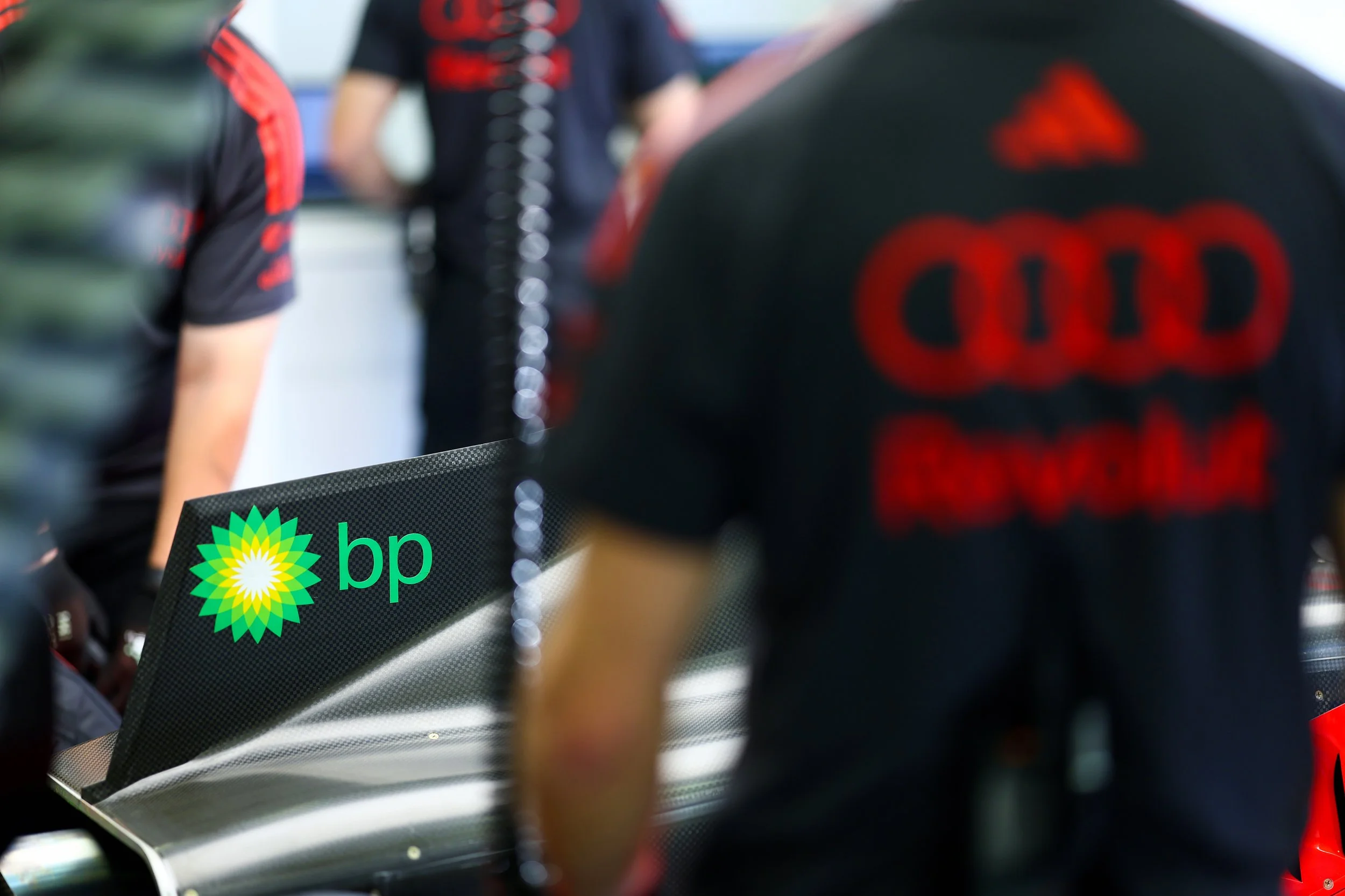
Perhaps Audi’s most important, and easily underestimated strategic decision was the early use and testing of the newly regulated sustainable fuel for 2026.
As BP was among the few fuel suppliers (besides Shell/Ferrari) that acquired early approval from the FIA regarding the finalised version of their sustainable fuel. This allowed Audi to adopt early use of race-approved fuel during both Bahrain tests. This has massive implications looking ahead.
True calibration, not approximations: every completed lap provides data on combustion efficiency, knock limits, fuel consumption, and the temperature and behaviour of the exhaust gases.
Real-world ERS integration: energy consumption correlation (boost, overtake) is set up in a way where the active fuel’s torque and reactions are taken into account, mapping the optimised hybrid strategy to actual combustion profiles, and not incomplete fuel tracings.
This brings a clear advantage, as other teams are still scrambling to get their sustainable fuels approved, and as rumours suggest, fuel partners such as Petronas are struggling to get their specifications green-lit, which may mean some teams will have to run a temporary mix, greatly limiting PU performance. Living with the opportunity, Audi may get a two to three month headstart compared to rivals. This will not win them Melbourne, but can immensely shorten the time needed to achieve the car’s full potential.
From Concept to Race Car
Where the Concept Sits After Testing
The philosophy of the R26 shone much brighter towards the end of testing than in the studio lights in Berlin. From the risk-averse architecture, it evolved into a reliable and seemingly nicely expandable concept, which is perhaps the most important takeaway. The team should gather much confidence from the fact that even after introducing such a massive design shift, the car behaved relatively the same, and even better than before.
Based on raw data, Audi’s performance during testing places them in the midfield, which is already a great achievement in itself. As the battle in the midfield is shaping up to be a close one, Audi needs to translate its reliability and strong basis into race results. However, the development direction seems trustworthy, and since the team is already using BP’s FIA-approved biofuel, Audi is definitely a team to watch for surprise results early in the season.
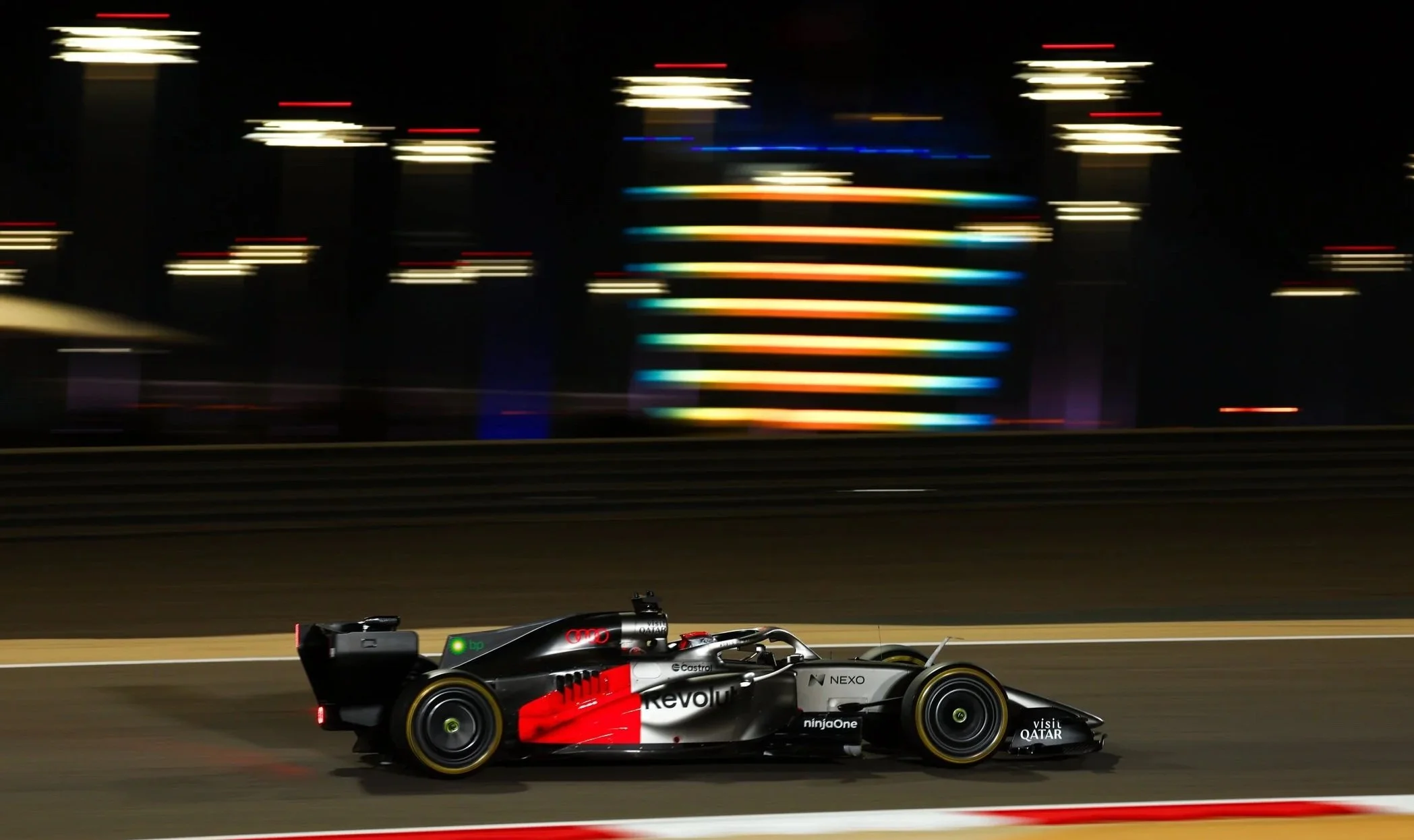
Audi R26 Under the Lights in the Sakhir Desert
All Audi images © AUDI AG / Audi Revolut F1® Team Content Hub, used for editorial purposes only.